- +91-8010038024
- sales@estmicrowave.com


THERMAL AND ELECTRICAL CONDUCTIVITY OF METALS
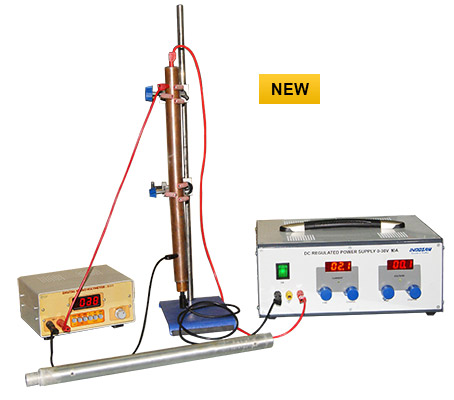
Principle and Working:
The heat conduction occurs due to the temperature difference between different locations of a body. In this setup a one-dimensional temperature gradient along a copper and aluminum rod is investigated. The quantity of heat dQ transported with time dt is a function of the cross-sectional area A and the temperature gradient dT/dx perpendicular to the surface is defined as:
dQ/dt = -λ A (dT/dx)
λ is the thermal conductivity of the substance.
The electrical conductivity of a metal (Copper & Aluminum) is determined by the resistance R of the rod and its geometric dimensions (l=0.315 m, A = 4.91 x10⁻⁴ m2)
σ = l/(A.R)
At room temperature T the conduction electrons in metal have a much greater mean free path than the phonons. For this reason heat conduction in metal is primarily due to the electrons. The relationship between the thermal conductivity λ and the electrical conductivity σ is established by the Wiedmann-Franz law:
λ/σ = L T
Where L is Lorenz number.
Exp-1 To determine the heat capacity of the calorimeter.
Exp-2 To study the thermal conductivity of copper and aluminum in a constant temperature gradient.
Exp-3 To determine the electrical conductivity of aluminum and copper by plotting a current-voltage characteristic curve.
Exp-4 To verify the Wiedmann-Franz law and find out the Lorenz number.
Enquiry Now